Honest Comparisons
Electric vs Microwave vs UV Bottle Sterilizers: Which Is Right for You?
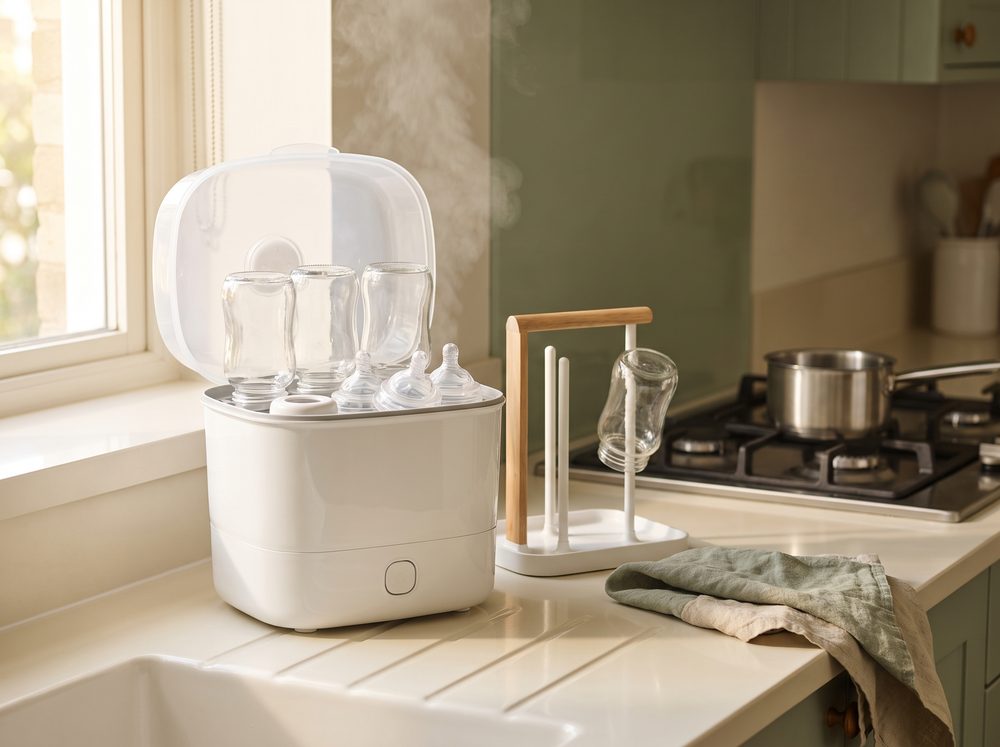
A countertop machine, a drying rack, and a pot of water. One of these is the right answer for your kitchen — and it isn't the same one for everybody.
There is a specific kind of tired that hits at 9 p.m., when the baby is finally down and there are eleven bottle parts in the sink. You want the version of this that takes the fewest steps, dirties the fewest dishes, and doesn't require you to stand at the stove watching a pot.
That's really the question underneath "which sterilizer should I buy." Not which one kills the most germs — nearly all of them do the job properly when used as directed — but which one you'll still be willing to use six weeks from now at 9 p.m. with one hand.
Honest framing up front: this is not a lab test. We haven't cultured plates or run cycle-time trials. This breakdown is based on published specs, manufacturer instructions, public health guidance, and years of feedback from bottle-feeding and pumping Mamas about what actually gets used versus what ends up in the cabinet. (If you're still sorting out where the milk goes afterward, start with our breast milk storage bags vs containers comparison.)
This post contains affiliate links. If you buy through them, we may earn a small commission — at no extra cost to you. We only point to things we'd actually tell a friend to get.
The short answer
- Electric steam sterilizers are the hands-off default. Load it, press one button, walk away. Biggest footprint, best for high-volume days.
- Sterilizer-and-dryer combos solve the part nobody warns you about — wet bottles you can't put away. Pricier, slower, worth it for pumpers.
- Microwave sterilizers and steam bags are the cheap, fast, small-kitchen answer. Fastest cycle of anything here, and the bags travel.
- UV sterilizers are dry, quiet, and gentle on parts — and the most expensive way to do this. Genuinely great for pacifiers and pump valves.
- Boiling water and the dishwasher sanitize cycle cost nothing extra and are legitimate methods, not shortcuts. They just cost you attention or time.
Most families end up with one main method and one backup for travel. That's not overbuying — that's what actually happens.
First: how often do you actually need to do this?
Worth knowing before you spend anything, because the answer changes which method makes sense. Everything that touches milk should be washed after every use — that part isn't optional. Full sanitizing is a separate, extra step on top of washing.
CDC guidance recommends sanitizing feeding items at least once daily for babies under two months old, babies born preterm, and babies with a weakened immune system, and notes that daily sanitizing may not be necessary for older, healthy babies if items are cleaned properly after each use. Your pediatrician knows your baby's situation and yours is the answer that counts — especially if your baby was born early or is under specialist care. Ask them, and follow their guidance over anything you read here.
Why this matters for your wallet: if you're sanitizing a full load once a day for a few months, a countertop machine earns its space. If you're topping up a couple of pump parts here and there, a $10 box of microwave bags may genuinely be all you ever need.
Electric steam sterilizers (the hands-off standard)
Who they're for: most bottle-feeding families, anyone running six or more bottles a day, and anyone who wants this to be one button and zero supervision.
A countertop electric steam sterilizer boils a small measured amount of water into steam and runs a cycle in roughly six to twelve minutes, then shuts itself off. Most hold six bottles plus nipples, rings, and pump parts, and many keep contents sanitized for up to 24 hours if you leave the lid closed. A Philips Avent electric steam sterilizer is the shape most people picture; the Baby Brezza sterilizer is the other name you'll see everywhere.
The honest cons:
- It owns real counter space. These are the size of a small rice cooker and they live out, because a sterilizer in a cabinet is a sterilizer you don't use.
- Bottles come out soaking wet. You still need a drying rack and a couple of hours before anything goes in a cupboard.
- Descaling is not optional. Hard water leaves mineral scale that slowly wrecks cycle times. Plan on a white vinegar rinse every few weeks, or use distilled water from the start.
- Fit is not universal. Tall, angled, and wide-neck bottles don't all stand up in every rack. Check your bottle against the model's capacity before you order.
- Steam is hot. Opening the lid too soon at the end of a cycle is a genuinely unpleasant surprise.
Sterilizer-and-dryer combos (the wet-bottle fix)
Who they're for: exclusive pumpers, anyone washing pump parts multiple times a day, and small kitchens with no room for both a machine and a sprawling drying rack.
A sterilizer-and-dryer combo runs a steam cycle then blows warm filtered air until everything is dry, so parts come out ready to store or reassemble. If you're doing the pump-wash-repeat cycle several times a day, this is the machine that removes a step you're currently doing by hand with a towel.
The honest cons:
- Expensive. Often two to three times a basic steam unit, for something you'll use for about a year.
- Long cycles. Sterilize-plus-dry can run 40 to 90 minutes. It's hands-off time, but it's not "I need this bottle now" time.
- Filters to replace. The drying function pulls air through a HEPA-style filter that's a recurring cost people forget about at purchase.
- More to break. Fans, heaters, and control boards versus a pot that will outlive all of us.
Bottles handled. Now feed yourself.
Recipes, research, and real-Mama Q&A every Tuesday. Try the Weekly for $1 your first month.
See the Weekly →Microwave sterilizers and steam bags (fast and cheap)
Who they're for: small kitchens, tight budgets, travel, grandparents' houses, and anyone who needs two clean bottles in the next four minutes.
Two versions here. A microwave steam sterilizer tub is a lidded plastic container you add water to and microwave for a few minutes — usually holding around four bottles. Microwave steam bags are the pouch version: a few tablespoons of water, 90 seconds to three minutes, and each bag is good for around 20 uses. For under $15 the bags are the single best value in this entire category, and they fold flat into a diaper bag.
The honest cons:
- Smaller capacity. Four bottles at best, often fewer with pump parts mixed in. Not a once-a-day full-load solution.
- Bags wear out. Twenty cycles goes faster than you'd think, and you're meant to tick the boxes on the bag to track it.
- Microwave-dependent. Wattage varies, so timing is a bit of a guess between kitchens, and not every item is microwave-safe — check your bottle's own instructions first.
- Very hot, very steamy. Opening a bag or tub straight out of the microwave is the most likely way to get a steam burn in this whole comparison. Let it sit a minute.
- Still wet at the end, like every steam method.
UV sterilizers (dry, quiet, pricey)
Who they're for: pacifier and small-parts households, quiet apartments, and anyone with items the manufacturer says shouldn't be steamed repeatedly.
A UV sterilizer uses ultraviolet light instead of heat, so there's no steam, no water to fill, and no scale. Items come out dry, and many models double as a storage cabinet you just leave things in. The small portable UV pacifier sanitizer pods are the genuinely useful version of this for most families — the diaper-bag-sized answer to a pacifier that hit the floor of a coffee shop.
The honest cons:
- The most expensive option here, often by a wide margin, for full-size cabinet models.
- Line-of-sight matters. UV only treats surfaces the light physically reaches, so loading is fussier — nothing can shadow anything else, and the inside of a long narrow bottle is the hard case.
- Items must be genuinely clean and dry first. Residue and water droplets block the light. UV is not a rescue for a poorly washed bottle.
- Marketing runs ahead of the evidence. Percentage claims vary wildly between brands and aren't independently standardized. If someone in your house is immunocompromised or your baby was preterm, ask your pediatrician what they want you using rather than trusting a box.
- Bulbs degrade over time, quietly, with no obvious sign that effectiveness has dropped.
Boiling water (free, and legitimate)
Who it's for: minimalists, tight budgets, glass-bottle users, power outages, travel, and anyone who wants to try before buying.
Submerge disassembled, already-washed parts in a stainless stockpot of water, bring to a rolling boil, and let it go for about five minutes, then lift items out with clean bottle tongs onto a clean towel. Follow your bottle manufacturer's instructions on boiling times and whether their material is boil-safe. It costs nothing, it fits every bottle ever made, and it will never need a firmware update.
The honest cons:
- It needs you. There is no timer and no auto-shutoff. You are the appliance, and you're standing there.
- Hard on plastic and silicone. Repeated boiling shortens the life of nipples and valves — expect to replace them sooner.
- Boiling water plus a newborn is a combination that requires you to be genuinely awake.
- Fishing parts out one-handed is nearly impossible, which is why the tongs are on the list.
The dishwasher sanitize cycle (the one people forget)
Who it's for: anyone who already owns a dishwasher with a sanitize or high-heat setting. Which is to say: check your dishwasher tonight before you buy anything.
Many dishwashers have a sanitize cycle that reaches high enough temperatures to do this job, and a hot rinse plus heated dry gets you washing and sanitizing in one pass — the only method here that does both. Small parts go in a closed-top dishwasher basket so nothing ends up in the heating element, and you'll still want a good bottle brush set for the pre-rinse.
The honest cons:
- Not every dishwasher has it, and not every bottle is top-rack dishwasher safe. Both need checking, once, before you rely on this.
- Slow. A sanitize cycle can run two hours or more, so it's an overnight strategy, not a "baby is hungry now" strategy.
- Small parts escape. Valves and membranes are famously good at ending up at the bottom of the machine.
- Rough on nipples over time — the high heat wears silicone faster than a gentle hand wash would.
Side by side
| Electric steam | Sterilize + dry | Microwave / bags | UV | Boiling | Dishwasher | |
|---|---|---|---|---|---|---|
| Typical cycle | 6–12 min | 40–90 min | 2–6 min | 10–60 min | ~5 min at a boil | 1–3 hrs |
| Hands-off | Yes | Yes | Mostly | Yes | No | Yes |
| Comes out dry | No | Yes | No | Yes | No | Usually |
| Capacity | ~6 bottles | ~6 bottles | ~4 bottles | Varies, fussy to load | Pot-sized | Large |
| Cost | $$ | $$$$ | $ | $$$$ | Free | Free |
| Counter space | Medium | Large | Stores away | Large | None | None |
| Travels | No | No | Bags: yes | Pods: yes | Anywhere with a stove | No |
| Descaling needed | Yes | Yes | Rinse only | None | None | No |
| Wear on nipples | Moderate | Moderate | Moderate | Lowest | Highest | High |
| Ongoing costs | Vinegar | Filters | New bags | Bulbs | None | None |
| One-handed at 9 p.m. | Good | Best | Good | Fair (fussy loading) | Worst | Good |
The verdicts
Buying notes that matter more than the brand
- Wash first, always. Sterilizing is a second step, not a replacement for cleaning. Nothing here rescues a bottle with milk residue in it.
- Check your bottle fits before you order. This is the number-one regret in this category — tall and angled bottles don't stand up in every rack.
- Buy for your drying situation, not just your washing one. Wet bottles you can't put away is the frustration people don't anticipate.
- Use distilled water in any steam machine if your water is hard. It's the cheapest possible way to make the appliance last.
- Store it clean and dry. Assembled damp bottles in a cupboard undo the whole exercise — let everything dry fully first.
- Put it where you already stand. Next to the sink, not across the kitchen. Our nursing station checklist covers setting up that spot properly.
Frequently asked questions
Do I really need a bottle sterilizer?
Not necessarily a machine, no. You need a way to sanitize, and boiling water or a dishwasher sanitize cycle both count. A dedicated appliance buys convenience and consistency, not a different outcome. Try the free methods for a week or two — if they fit your life, you've saved yourself the purchase and the counter space.
How often should I sterilize bottles?
CDC guidance points to sanitizing at least daily for babies under two months, preterm babies, and babies with a weakened immune system, and notes it may not be necessary daily for older healthy babies whose items are properly cleaned after each use. Your pediatrician's answer for your baby beats the general rule — ask them, especially in the early weeks.
Is UV as effective as steam?
They work differently and both have real limits. Steam is thorough on anything the steam reaches; UV only treats surfaces the light physically hits, so loading matters much more and long narrow bottles are the weak spot. UV's genuine advantages are that it's dry, quiet, gentle on parts, and portable. If effectiveness for a medically fragile baby is the deciding factor, that's a question for your pediatrician, not a spec sheet.
Can I sterilize breast pump parts the same way?
Usually, but follow your pump manufacturer's instructions — some valves and membranes are not meant for repeated high heat, and boiling is often the harshest option for them. Wash after every use, and take questions about milk handling or your pumping routine to an IBCLC.
Do bottles need to be dry before I put them away?
Yes — store everything fully dry and disassembled. Trapped moisture in a sealed bottle is exactly the environment you just spent ten minutes eliminating. This is why sterilizer-dryer combos exist, and why a good drying rack is worth the counter space if you're using a steam method.
When can I stop sterilizing?
Many families ease off once baby is a few months old and thorough washing is happening consistently, but the timing depends on your baby's age, health, and how your items get cleaned. Your pediatrician is the right person to tell you when to stop — it's a quick question at a well visit.
Once the bottles are handled, feed yourself too
Here's the part nobody warns you about: you'll get the whole bottle system dialed in, look up at 9 p.m., and realize you haven't eaten a real meal since lunch. That's the gap we make things for — 10 Make-Ahead Meals to start, the Recipe Vault of 50 nursing-friendly recipes, and a Hydration & Snack Station printable for the spot where you actually feed. Prefer a paperback on the shelf? The full Nourished Mamma Cookbook is on Amazon.
Ten make-ahead meals, free, in your inbox
Freezer-friendly, one-handed, no cooking from scratch in the newborn fog. No card, no catch.
Grab the free meals →This article is educational and not medical advice. Questions about cleaning, milk handling, or your baby's needs are great questions for your pediatrician or an IBCLC — and if your baby was born preterm or is under specialist care, follow your care team's guidance over general information. Always follow the instructions that came with your bottles, pump, and appliance. As an Amazon Associate we earn from qualifying purchases.