Mama Questions
How Do I Cook Dinner With a Newborn?
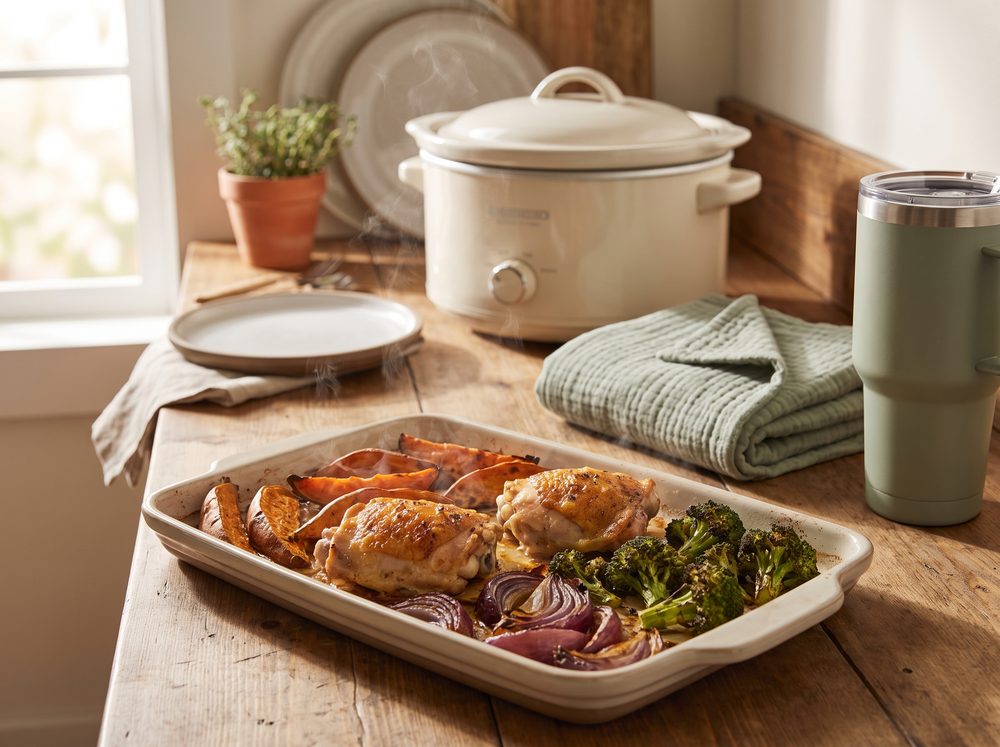
Dinner that finishes without you is the whole trick.
Quick answer: mostly, you don't cook the way you used to — you assemble, reheat, or dump-and-walk-away. Find one 15-minute window earlier in the day when baby is settled or someone else is holding them, and use it to start something that finishes on its own: a slow cooker meal, a sheet pan, a freezer meal into the oven. The cooking happens on the appliance's schedule instead of yours.
Here's the thing nobody says out loud: the reason dinner feels impossible isn't that you've lost the skill. It's that cooking as most of us learned it assumes twenty to forty uninterrupted minutes standing at a stove, with both hands, at the exact hour a newborn is least likely to cooperate. That window doesn't exist right now. So the fix isn't trying harder — it's cooking a different way for a few months.
This post contains affiliate links. If you buy through them, we may earn a small commission — at no extra cost to you. We only point to things we'd actually tell a friend to get.
The three-part system that actually works
Every workable postpartum dinner strategy comes down to the same three moves. You don't need all three every day — most nights, one is enough.
- Shift the timing. Start dinner in the morning, not at dinnertime. This single change solves more than any recipe.
- Let an appliance do the cooking. A programmable slow cooker or an electric pressure cooker works whether or not you're in the room. So does the oven.
- Front-load the decisions. A pantry stocked with eight or ten "these make a meal" items means dinner is never a question you have to answer at 5:45 p.m. with a crying baby.
Everything below is just detail on those three. Here are the questions Mamas actually ask us.
When am I actually supposed to cook?
Not at 6 p.m. Late afternoon and early evening are the fussiest hours for most newborns — the stretch a lot of parents call the witching hour — which is precisely when the traditional dinner hour lands. Fighting that is a losing game.
Instead, look for your window in the morning, or in the twenty minutes right after a good feed when babies tend to be calmest and drowsiest. That's when you load the slow cooker, chop the sheet pan veg, or move tomorrow's dinner from the freezer to the fridge. By the time evening arrives, dinner is either already done or fifteen minutes from the oven.
One more permission slip: dinner does not have to be at dinnertime. Plenty of new parents eat their real meal at 4 p.m., or at 8:30 p.m. after the baby finally settles. The clock is a suggestion.
Can I cook while babywearing?
You can be in the kitchen wearing your baby — but not at the stove, and not over anything hot or sharp. Carrier manufacturers and babywearing educators are consistent on this: keep a worn baby away from heat sources, boiling liquids, hot oil, and knives. It's the one hard line in an otherwise flexible chapter.
What babywearing is great for is the low-risk half of cooking. Loading the slow cooker, unpacking groceries, wiping counters, washing dishes, chopping at a counter well away from the range. If you're doing a lot of this, a comfortable soft structured carrier earns its keep. A bouncer or floor seat parked safely on the floor where you can see it is the other classic move for the stove-adjacent tasks.
What's the least-effort dinner that's still real food?
A sheet pan, by a wide margin. Protein plus chopped vegetables, a glug of oil, salt, into a 425°F oven for 25–30 minutes. Hands-on time is under ten minutes, everything cooks at once, and there's a single half sheet pan to wash. Line it with parchment and there's barely that.
The other two on the podium:
- Rotisserie chicken + bagged salad + microwave rice. Zero cooking, and it feels like a real plate.
- Beans and jarred sauce over pasta. Ten minutes, entirely from the pantry, and genuinely good with a fistful of spinach wilted in at the end.
If you want more of this kind of dinner in rotation, our dump-and-go slow cooker dinners are built on exactly this logic.
Dinner, decided for you
10 Make-Ahead Meals for New Mamas — freezer-friendly, one-handed, and designed to be cooked in a 15-minute window. Instant download.
Shop the guide →Is it okay if we eat takeout and frozen meals most nights?
Yes. Truly. Eating something beats eating nothing, and this stretch is temporary — you are not setting a lifelong pattern by ordering Thai three nights this week.
If you want to nudge the nutrition without adding effort, use the "add one thing" rule: whatever arrives at the door or comes out of the freezer, add a single fresh item to it. A handful of spinach. A hard-boiled egg. A spoonful of yogurt. Some fruit on the side. That's a realistic upgrade for a Mama running on four hours of sleep. Cooking from scratch is not.
How do I use a slow cooker or Instant Pot when I can't hover?
Hovering is exactly what they're designed to eliminate. Load it during your calm morning window, set it, and don't think about it again until it smells like dinner.
The upgrade is dump bags: raw protein, chopped veg, and sauce sealed together in a gallon freezer bag and frozen flat. On the day, you tip the frozen block straight into the pot. No chopping, no thawing, no decisions. Make four or five of them in one session while you still have help, and you've bought yourself a week of dinners. Our guide to postpartum freezer meals walks through which dishes freeze well and which don't.
A small rice cooker deserves a mention too — it turns "there's nothing to eat" into a base for leftovers, beans, or an egg on top, with one button.
What if my baby cluster feeds right at dinnertime?
Assume it will, and build dinner so it doesn't need you at 6 p.m. Cluster feeding in the late afternoon and evening is extremely common in the newborn weeks — it's one of the most predictable unpredictable things about a new baby.
Two practical moves. First, cook earlier so a plate is waiting. Second, set up your feeding spot so you can eat while you feed if dinner has to happen sitting down: a big insulated water bottle with a straw and something you can manage with one hand. We have a whole list of one-handed snacks for nursing Mamas if you need ideas.
What should I keep in the pantry so I never have "nothing to eat"?
Think in building blocks, not meals. You want eight to ten shelf-stable things where any two or three combine into dinner without a recipe:
- Canned beans and canned tuna or salmon
- Pasta, jarred sauce, and microwave rice pouches
- Boxed broth, frozen vegetables, frozen cooked rice
- Eggs, shredded cheese, tortillas
Those alone give you burrito bowls, tuna pasta, bean soup, quesadillas, and fried rice — none of which require a plan. If your kitchen isn't set up for this yet, our postpartum kitchen starter kit covers the small handful of tools that pull the most weight, and a pair of heavy-duty kitchen shears genuinely replaces a knife for most one-handed jobs.
How can my partner actually help with dinner?
By owning a job, not doing a task. "What do you want for dinner?" hands the hardest part — the deciding — straight back to you. "I've got dinner Tuesday, Thursday, and Sunday" is help.
The three standing jobs that change the most: the weekly grocery order, restocking the snack station, and doing the dishes every single night so the kitchen is usable in the morning. If your partner wants a concrete starting list, we wrote one: what to stock the kitchen with before baby comes.
Do I need to cook special food because I'm breastfeeding?
Practically speaking, no — you can eat the same dinner as everyone else at your table, and you should not be cooking twice. That's the whole reason the sheet-pan-and-slow-cooker approach works for nursing Mamas: it feeds the household in one go.
Anything beyond that — specific nutrition needs, restrictions, supplements, or questions about your milk — is a conversation for your healthcare provider or an IBCLC, not a blog post. They know your situation; we don't.
How do I cook with only one hand?
Pick recipes with no simultaneous steps. One-handed cooking falls apart the moment something needs stirring while something else is browning. It works fine when everything goes into one vessel and then waits — sheet pans, slow cookers, soups, baked pasta.
The rest is removing two-handed moments before they happen: pre-chopped or frozen vegetables instead of raw, jarred sauce instead of built-from-scratch, shears instead of a knife, and glass containers you can microwave and eat straight out of.
What if I'm too tired to even reheat something?
Then eat the food that requires nothing. Yogurt. Cheese and crackers. A peanut butter sandwich. A banana. Leftovers cold, standing at the counter, out of the container. Keeping genuinely no-prep food in the house isn't giving up — it's the plan working. The only bad dinner in the newborn weeks is the one you skip.
When will cooking feel normal again?
In pieces, and on a timeline that's different for everyone. Most Mamas start to notice a first stretch of predictable time somewhere around three to six months, as naps lengthen and feeds get faster. Some of it comes back sooner, some later, and a second baby resets the whole thing.
Until then, the kindest thing you can do is stop measuring this kitchen against your pre-baby kitchen. You're not failing at cooking. You're cooking in the hardest conditions you'll ever cook in, and you're still feeding people.
The short version
Cook earlier in the day. Let a machine finish the job. Keep a pantry that makes dinner obvious. Say yes to takeout without guilt, add one fresh thing when you can, and hand a whole job to your partner. If you want it all done for you, we've built exactly that: 10 Make-Ahead Meals to get through the first weeks, the Recipe Vault of 50 nursing-friendly recipes for the whole first year, and a Hydration & Snack Station printable for the feeding spot. Prefer a paperback on the counter? The Nourished Mamma Cookbook is on Amazon.
Nourishment in your inbox every Tuesday
Recipes, research, and real-Mama Q&A. Try the Weekly for $1 your first month.
See the Weekly →This article is educational and not medical advice. For decisions about your nutrition, recovery, or feeding, please talk to your healthcare provider or an IBCLC. As an Amazon Associate we earn from qualifying purchases.